Third Galactic Republic
Created by Darth Serus on Mon Oct 1st, 2012 @ 3:08am
Third Galactic Republic

"The First Republic was the Republic of legend, greater than distance or time. No need to note where it was or whence it came, only to know that… it was the Republic. Now, we restore that which was once benevolent and grand. Now, we restore the Golden Age of the Republic!" - Supreme Chancellor Valaha, paraphrasing from the Journal of the Whills, and the Bith who served as the first Supreme Chancellor of the Third Galactic Republic.
→ A Brief History of the Third Republic
POLITICAL INFORMATION
- Type of government: Unicameral Federal Republic
- Founding document: The Grand Proclamation
- Constitution: New Galactic Constitution
- Head(s) of State: Supreme Chancellor
- Current Head(s) of State: Supreme Chancellor Paralles
- Head(s) of Government: Supreme Chancellor; Speaker of the Senate
- Current Head(s) of Government: Supreme Chancellor Paralles; Speaker Damask Hul
- Commander(s)-in-chief: Supreme Commander
- Current Commander(s)-in-chief: Supreme Commander Grendul
-
Executive branch:
- Galactic Senate
- Office of the Supreme Chancellor
- Legislative branch: Galactic Senate
-
Judicial branch:
- Federal Courts
- Supreme Court
SOCIETAL INFORMATION
- Capital: Coruscant
- Official language: Galactic Basic Standard
- Currency: Galactic Credit Standard
- State religious body: Reborn Jedi Order
- National holiday: Republic Day
HISTORICAL INFORMATION
- Formed from: Scattered Second Galactic Republic remnants & tribes (incl. Galactic Federation Triumvirate)
- Date of establishment: 380 ABY (formally), circa 480-500 ABY (functionally)
SELECTED HISTORY
"The Republic was not restored in a single day, nor by a single proclamation. It was rebuilt route by route, world by world, and promise by promise. In time, many would forget that every promise carried a price."
– Excerpt from The Long Republic, published 1,173 ABY.
OVERVIEW
The Third Galactic Republic was formally established in 380 ABY through the Grand Proclamation, although it would not become a fully functioning galactic state until approximately a century later. Emerging from the violence, fragmentation and historical devastation of the New Galactic Dark Age, the Republic was intended to restore the benevolent traditions of the ancient Galactic Republic while avoiding the militarism, centralisation and authoritarian excesses associated with later governments.
Its founders deliberately limited the size of the central government and its Judicial Forces. Planetary governments, sector authorities, the Reborn Jedi Order and private organisations were expected to support the Republic during emergencies. This arrangement encouraged local autonomy and restrained the growth of a permanent military, but it also created structural weaknesses that would shape the following eight centuries.
Chief among these was the growing importance of GalactaWerks. Formed before the Grand Proclamation from the merger and consolidation of Czerka Arms, Baktoid Armour and numerous surviving commercial, military and industrial interests, GalactaWerks became essential to the Republic's reconstruction. Over time, the corporation embedded itself within galactic trade, currency, logistics, defence, infrastructure and frontier administration.
The history of the Third Republic may therefore be understood as the gradual development of a contradiction. The Republic sought peace without militarism, prosperity without heavy taxation, and galactic influence without direct administration. GalactaWerks offered each of these, but in doing so accumulated powers that the Republic could neither easily regulate nor replace.
THE NEW GALACTIC DARK AGE
301–380 ABY
The Third Republic arose from the collapse of the post-Yuuzhan Vong political order. The New Mandalorian Crusade, the Great Mandalorian Civil War, the withdrawal of the Imperial remnants into Bastion and the closure of the Unknown Regions by the Chiss Ascendancy contributed to a prolonged period of fragmentation and decline.
During this era, whole regions lost access to central government, reliable trade, common currency and secure hyperspace routes. Archives, population records and astrogation repositories were destroyed across several major conflicts, leaving much of the period only partially understood by later historians.
The surviving elements of the Galactic Federation Triumvirate continued to claim legitimate galactic authority, but their practical influence varied considerably. Local governments, military commands, Jedi enclaves, corporate settlements and planetary coalitions increasingly acted independently.
FORMATION OF GALACTAWERKS
330 ABY
GalactaWerks was formally established in 330 ABY through the merger, absorption and reorganisation of numerous surviving corporations. Its principal ancestral organisations included Czerka Arms and Baktoid Armour, alongside transport, medical, mining, agricultural, droid, colonial and private security interests.
Publicly, the consolidation was justified as a necessary response to the collapse of galactic supply chains. A single organisation capable of coordinating shipping, industrial production, food distribution, military equipment and reconstruction offered clear advantages during a period of widespread instability.
The corporation's earliest leaders also recognised the strategic importance of reconstruction. Control over transport, data, manufacturing standards, planetary debt and essential infrastructure offered influence greater than conventional territorial conquest. GalactaWerks did not initially seek to govern the galaxy directly. Instead, it sought to ensure that any future galactic government would be forced to rely upon systems that GalactaWerks owned, financed or maintained.
When the Third Republic was formally established fifty years later, GalactaWerks had already positioned itself as one of the few organisations capable of supporting its ambitions.
THE GRAND PROCLAMATION
380 ABY
The Grand Proclamation formally established the Third Galactic Republic and reorganised surviving Jedi institutions into the Reborn Jedi Order. The Bith statesman Valaha became the first Supreme Chancellor, while Jedi Grand Master Junun Waay emerged as one of the most influential architects of the new settlement.
The Republic was founded upon a deliberate rejection of the vast standing armies, emergency dictatorships and centralised administrations associated with previous galactic regimes. The new Judicial Forces were designed primarily for law enforcement, crisis response, frontier protection and limited military action.
This restrained settlement proved politically attractive to worlds exhausted by war. However, the Republic of 380 ABY remained more an agreement of intention than a fully functioning state. Many systems continued to use local currencies, operate independent fleets and maintain separate legal and commercial structures.
THE RESTORATION OF THE GALACTIC CREDIT
426–447 ABY
One of the earliest and most important achievements of the Third Republic was the restoration of the Galactic Credit Standard. During the New Galactic Dark Age, the old credit system had fragmented into local currencies, military scrip, corporate notes, commodity-backed certificates, barter arrangements and surviving Imperial issues.
The Credit Restoration Acts established a common legal standard for galactic currency and created the institutions necessary to regulate exchange, debt and interstellar trade. The process was gradual, with many remote worlds resisting the loss of their local currencies or disputing the terms under which older debts would be converted.
GalactaWerks provided much of the infrastructure required to implement the new system. Its vessels transported currency and secured financial materials, while its communications networks, clearing houses, accounting systems and droids enabled reliable transactions across distant sectors.
The restoration of the credit transformed the Republic. Trade expanded, taxes could be collected consistently, food and medical aid could be purchased across sectors, and damaged worlds gained access to reconstruction finance.
It also allowed GalactaWerks unprecedented insight into galactic production, shipping, debt and consumption. Later historians would observe that the Republic created the Galactic Credit Standard, but GalactaWerks created the machinery through which the galaxy used it.
THE CORUSCANT RECOGNITION
480–500 ABY
The term "Coruscant Recognition" is used by historians to describe the period in which the Third Republic became a functional galactic state rather than a loose restoration movement.
During these decades, most major Republic sectors accepted the Galactic Credit Standard, established regular Senate representation and recognised Coruscant as the uncontested federal capital. Judicial authority became increasingly standardised, while major hyperspace routes were restored to regular use.
The process was not governed by a single treaty. Instead, it consisted of hundreds of accessions, legal agreements, economic settlements and infrastructure projects. By the beginning of the sixth century ABY, the Republic had achieved a level of legitimacy and practical authority not seen since before the New Galactic Dark Age.
THE SULARIN FRONTIER WAR
561–567 ABY
The Sularin Frontier War was the first significant military conflict fought by the consolidated Third Republic. It began as a dispute over the restoration of an ancient hyperspace route through a region controlled by independent frontier settlements, pirate dynasties, former military commands and local toll authorities.
The Republic and GalactaWerks argued that reopening the route would improve commerce, reduce travel times and bring isolated systems into the wider economy. Local rulers warned that the project would destroy their existing trade, undermine their political independence and expose their worlds to corporate domination.
Tensions escalated when GalactaWerks survey vessels entered disputed space under Judicial escort. Several ships were seized, customs stations were attacked and independent militias began targeting Republic-aligned settlements.
The Judicial Forces initially succeeded in defending convoys and recovering several stations, but proved unable to sustain a large territorial campaign. GalactaWerks supplied transports, battle droids, Marines, engineering units and logistical bases, allowing the Republic to conduct a prolonged advance.
The war ended in Republic victory. The disputed route was reopened and the principal frontier militias were disarmed. GalactaWerks received temporary authority to administer captured ports, depots and communications facilities until civilian government could be restored.
Many of these temporary arrangements lasted for decades. The war established several precedents that would later become central to Republic frontier policy, including the use of corporate forces under Judicial commission, the economic restructuring of defeated systems and the classification of armed resistance to commercial integration as organised criminality.
In Core histories, the conflict was remembered as a successful campaign against piracy and warlordism. Within the affected frontier systems, it became known as the first corporate war of the Third Republic.
THE CHANDRILA CONSTITUTIONAL CRISIS
644–647 ABY
The Chandrila Constitutional Crisis emerged following a series of assassinations, bombings and acts of sabotage directed against Republic officials and interstellar infrastructure. The incumbent government proposed emergency legislation granting the Supreme Chancellor and Judicial Forces expanded powers to investigate suspects across sector boundaries.
A coalition of senators led by representatives from Chandrila argued that the proposed measures violated the Grand Proclamation and risked recreating the authoritarian structures the Third Republic had been founded to prevent.
The dispute paralysed the Senate. Several planetary courts refused to recognise federal arrest warrants, Judicial officers questioned the legality of their orders, and a number of senators temporarily withdrew from proceedings.
The crisis intensified when evidence emerged that private intelligence reports supplied to the government had overstated the coordination and scale of the threat. GalactaWerks denied deliberately misleading Republic authorities, maintaining that its assessments had been made in good faith.
Jedi mediation eventually produced a compromise. The emergency proposals were withdrawn, the Chancellor's government collapsed and new constitutional restrictions were placed upon the use of executive security powers.
The settlement was celebrated as a major victory for civil liberty and planetary sovereignty. In the longer term, however, the restrictions left successive governments increasingly reliant upon private intelligence, corporate security and local enforcement bodies whose activities were subject to less direct scrutiny.
THE KESSEL CAMPAIGN
731–738 ABY
The Kessel Campaign began as a prolonged crisis involving criminal syndicates, prison contractors, spice interests, bonded labour systems and competing local authorities. Disruption of the Kessel trade threatened medical production, industrial supply and several major hyperspace routes.
Republic efforts to negotiate a settlement repeatedly failed. Syndicate-backed fleets attacked shipping, prison populations revolted and Hutt-aligned interests intervened through proxies.
The Judicial Forces imposed a blockade and began securing the principal orbital facilities. GalactaWerks deployed Marines, battle droids, transports, mining equipment and specialist engineering teams to support the campaign.
Much of the fighting took place within mining complexes, prison installations and subterranean transport networks. GalactaWerks droids proved particularly effective in hazardous environments where organic casualties would otherwise have been severe.
The Republic eventually dismantled the principal syndicates and formally abolished several systems of slavery and bonded criminal labour. GalactaWerks was subsequently awarded long-term contracts to oversee extraction, transport, security and medical provision.
Supporters of the campaign presented Kessel as proof that GalactaWerks could succeed where government and local authority had failed. Critics argued that illegal exploitation had merely been replaced by contractual dependency, penal labour and corporate monopoly.
The campaign also produced the first fully integrated GalactaWerks expeditionary command, combining organic Marines, droid formations, naval assets, logistics, intelligence and public relations under a unified corporate structure. This model would later be expanded during the Outer Rim Conflicts.
THE GREAT CONVOY CRISIS
842–848 ABY
The Great Convoy Crisis followed a combination of crop failures, transport disruption, piracy and instability along several frontier hyperspace routes. Food shortages spread across numerous remote sectors, while local governments struggled to secure sufficient shipping.
GalactaWerks proposed the creation of a centralised convoy network operating under Republic authority. Participating worlds received guaranteed food shipments, security escorts, emergency medical supplies and access to reconstruction credit.
The system succeeded in preventing widespread famine. Piracy declined, prices stabilised and several failing planetary economies recovered.
Participation also required worlds to accept exclusive shipping agreements, corporate port authorities, standardised agricultural quotas, security inspections and long-term debt arrangements. Local exporters were frequently restricted from trading outside the convoy system, while Republic-designated markets received priority access to frontier produce.
The crisis therefore preserved millions of lives while significantly weakening frontier economic sovereignty. The ports, tracking systems and customs procedures established during the convoy period later formed part of the infrastructure used to monitor and restrict trade with the original Outer Rim Alliance.
THE RISE OF THE ORIGINAL OUTER RIM ALLIANCE
c. 900–990 ABY
The original Outer Rim Alliance did not begin as a unified separatist state. It developed gradually from a number of overlapping economic, political and security organisations.
These included frontier trade leagues, agricultural cooperatives, local defence compacts, veterans' associations, anti-corporate unions and planetary autonomy movements. Their members objected to compulsory export quotas, exclusive GalactaWerks contracts, corporate control of ports and utilities, and the limited political influence of distant frontier systems.
The Republic initially treated these organisations as separate local disputes. GalactaWerks increasingly argued that they represented a coordinated campaign against lawful commerce and galactic stability.
THE ALBA CONGRESS
968 ABY
Representatives from several frontier movements met on Alba in 968 ABY and produced a common political charter. The delegates did not initially call for complete independence from the Third Republic.
Their principal demands included the termination or renegotiation of compulsory corporate contracts, restoration of planetary tariff powers, local control over security forces, independent review of GalactaWerks conduct and protection of essential infrastructure from permanent corporate ownership.
The Senate referred many of the proposals to committees and review bodies. Limited concessions were discussed, but no comprehensive settlement was reached. Over the following decade, the Congress developed into a permanent Alliance institution.
THE ALLIANCE BORDER EMERGENCY
981–990 ABY
Relations between the Republic and Alliance-aligned worlds deteriorated throughout the 980s ABY. GalactaWerks restricted trade through several disputed systems, while Alliance militias began escorting independent convoys and seizing corporate cargoes.
The Republic imposed increasing controls upon the movement of weapons, ships and industrial equipment into Alliance space. These measures were officially intended to prevent piracy, smuggling and armed separatism, but Alliance leaders characterised them as an economic blockade.
Skirmishes between corporate security, Judicial patrols and Alliance militia became increasingly common. The crisis finally escalated into open war when Alliance forces broke the border blockade in 990 ABY.
THE FIRST OUTER RIM CONFLICT
990–992 ABY
The First Outer Rim Conflict ended in decisive Republic victory. Judicial Forces, supported heavily by the GalactaWerks Marines, dismantled Alliance military positions, seized key hyperspace routes and restored former Alliance worlds to Republic administration.
The original Outer Rim Alliance was formally dissolved following the Second Battle of Alba in 992 ABY. Its militia was disbanded, its leadership was killed, captured or driven into exile, and its member systems were returned to Republic control.
Although the Republic won the military conflict, it did not resolve the economic and political grievances that had produced the Alliance. The post-war settlement instead transferred unprecedented authority to GalactaWerks through a series of reconstruction and security operations collectively known as the Repatriation Campaigns.
THE REPATRIATION CAMPAIGNS
992–c. 1040 ABY
The Repatriation Campaigns were a prolonged programme of military pacification, political reintegration, economic restructuring and social reform imposed across former Alliance space following the First Outer Rim Conflict.
The Republic described the campaigns as a necessary effort to restore lawful government, rebuild infrastructure, disarm former militias, compensate civilians and return defeated worlds to peaceful participation in galactic society.
In practice, the campaigns transformed the relationship between GalactaWerks and the Outer Rim. The corporation moved beyond the role of military contractor and became responsible for administration, security, employment, trade and reconstruction across much of the former Alliance.
PHASE I: DISARMAMENT AND SECURITY
GalactaWerks Marines and Judicial Forces seized former Alliance depots, ports, communications centres and military facilities. Weapons registration was imposed, militia officers were detained or excluded from public office, and local defence forces were disbanded or placed beneath Republic supervision.
Curfews, travel restrictions and security zones were established across several worlds. Droid garrisons were deployed to protect infrastructure and suppress organised resistance.
Although these powers were described as temporary, emergency security arrangements remained in place for decades in some regions.
PHASE II: ADMINISTRATIVE RESTORATION
Planetary governments were reviewed for loyalty, competence and involvement in the war. Officials associated with the Alliance were removed, while Republic commissioners and GalactaWerks intendants assumed control of key departments.
Local courts, customs authorities and civil services were reorganised. Teachers, judges, port officials and senior administrators were subjected to political vetting.
Damaged infrastructure was transferred into corporate trusteeship until local governments were considered capable of resuming control. In many cases, this control was never fully returned.
PHASE III: ECONOMIC REPATRIATION
Former Alliance currencies and wartime certificates were abolished, and the Galactic Credit Standard was reimposed throughout the region. Planetary debts were restructured, while damaged public assets were sold or transferred to GalactaWerks subsidiaries.
Reconstruction loans were commonly secured against ports, mines, farmland, power networks or future tax revenues. Agricultural quotas and exclusive trade agreements redirected frontier production towards Republic markets.
Worlds damaged during the war were therefore required to finance their own reconstruction. GalactaWerks rebuilt infrastructure using corporate credit, then received long-term control of planetary resources and services in repayment.
PHASE IV: SOCIAL REINTEGRATION
Republic authorities sought to suppress separatist identity without openly prohibiting local culture. School curricula were revised, Alliance military symbols were restricted and public memorials emphasised reconciliation rather than resistance.
Veterans were encouraged to join corporate security forces or participate in state-approved associations. Scholarships and employment programmes relocated promising young citizens to Republic institutions elsewhere in the galaxy.
The Reborn Jedi Order participated in peace programmes, mediation efforts and civic reconstruction. While many Jedi acted with genuine humanitarian intent, their involvement strengthened the perception that the Order had become an instrument of Republic authority.
Alliance identity increasingly survived through families, unions, veterans' groups, songs, local memorials and oral history rather than formal institutions.
PHASE V: NORMALISATION
By the middle of the eleventh century ABY, most formal emergency powers had ended. GalactaWerks no longer required military occupation authority across much of the former Alliance because it controlled the infrastructure upon which local society depended.
Ports, power systems, communications, hospitals, mines, food contracts, transport networks and planetary debt remained tied to GalactaWerks. The corporation's authority increasingly rested upon contracts and dependency rather than direct force.
This was the lasting success of the Repatriation Campaigns. Former Alliance worlds had been restored to the Republic, but their capacity to act independently had been permanently weakened.
THE ALBA RESTORATION CRISIS
1087–1091 ABY
The Alba Restoration Crisis represented the most significant peaceful challenge to the Repatriation system before the Second Outer Rim Conflict.
Nearly a century after the First Outer Rim Conflict, a reformist government was elected on Alba. Its leaders did not seek secession from the Republic. They called for the peaceful renegotiation of Repatriation-era contracts, the restoration of local control over ports and utilities, and legal recognition for former Alliance veterans' organisations.
Several neighbouring worlds supported the programme, while moderate senators on Coruscant argued that limited concessions could bring a permanent end to frontier unrest.
GalactaWerks warned that the proposed reforms would undermine essential trade and security agreements. The corporation maintained that allowing Alba to withdraw from established contracts would destabilise the wider regional economy.
Corporate credit was reduced, shipping insurance became more difficult to obtain, industrial replacement parts were delayed and several major employers suspended operations. GalactaWerks publicly denied attempting to force the government from office, describing the disruption as an unavoidable consequence of political uncertainty.
The crisis escalated after a series of strikes, riots and acts of sabotage. A bombing against a Republic administrative facility killed several officials and civilians. Responsibility for the attack was never conclusively established.
The Republic declared a limited state of emergency. Judicial Forces and GalactaWerks Marines entered Alba to restore order, while several members of the reformist government were arrested or forced to resign.
A subsequent Senate inquiry found no evidence of a coordinated GalactaWerks conspiracy. It criticised communication failures, excessive commercial pressure and insufficient political oversight, but no senior corporate official was prosecuted.
The failure of the Alba reforms had lasting consequences. Moderate autonomy movements concluded that peaceful renegotiation was impossible, veterans' networks moved underground and GalactaWerks demonstrated that it could defeat an elected government through economic pressure without openly violating Republic law.
Later Outer Rim Alliance histories would describe the crisis as the moment in which reconciliation finally died.
THE LONG INTERWAR PERIOD
1091–1189 ABY
The century following the Alba Restoration Crisis was marked by outward stability and growing internal resentment. Former Alliance worlds remained within the Republic, trade continued and no unified separatist government openly challenged Coruscant.
Beneath this stability, clandestine veterans' organisations, labour movements and political networks preserved Alliance identity. Periodic strikes, sabotage campaigns, riots and local uprisings were suppressed by planetary authorities, GalactaWerks security or limited Judicial intervention.
The Reborn Jedi Order became increasingly involved in political mediation and conflict resolution across the Outer Rim. Disagreement over the Order's relationship with the Republic contributed to the development of philosophical divisions that would later produce the Rift Jedi.
Within the Senate, criticism of both GalactaWerks and the Coalition's limited-government philosophy increased. Early centralist pressure groups argued that the Republic had surrendered military, administrative and economic authority to private interests.
GalactaWerks continued to expand its control over defence procurement, droid production, transport and frontier administration. Publicly, the corporation remained one of the Republic's most respected institutions. In former Alliance space, it was increasingly regarded as the enduring face of occupation.
THE SECOND OUTER RIM CONFLICT
1189–1195 ABY
The Second Outer Rim Conflict began following widespread anti-GalactaWerks riots in 1189 ABY. Union-led uprisings seized or destroyed corporate facilities across Alliance-aligned worlds, overwhelming local security and prompting Republic intervention.
Unlike the original Alliance, the renewed movement possessed a developed national identity, broad popular support and extensive networks formed during the Repatriation period. The conflict expanded into a major war involving Republic forces, GalactaWerks Marines, planetary militias, the Reborn Jedi Order and the newly formed Rift Jedi.
Although the Republic achieved a military victory, it was unable to impose the complete dissolution of the Alliance. The Belsmuth-Quelii Treaty of 1195 ABY granted the Outer Rim Alliance limited autonomy as a semi-independent protectorate within the Third Republic.
GalactaWerks was expelled from most recognised Alliance worlds, while the Republic retained control over major trade arrangements and placed military restrictions upon the new state.
The settlement ended open warfare but resolved few of the conflict's underlying causes. The Alliance remained dissatisfied with its limited sovereignty, the Republic resented the loss of authority, GalactaWerks sought to recover its influence, and the Jedi schism permanently damaged the moral legitimacy of the Reborn Order.
JUDICIAL FORCES

Basic Rank Structure (Naval/Military)
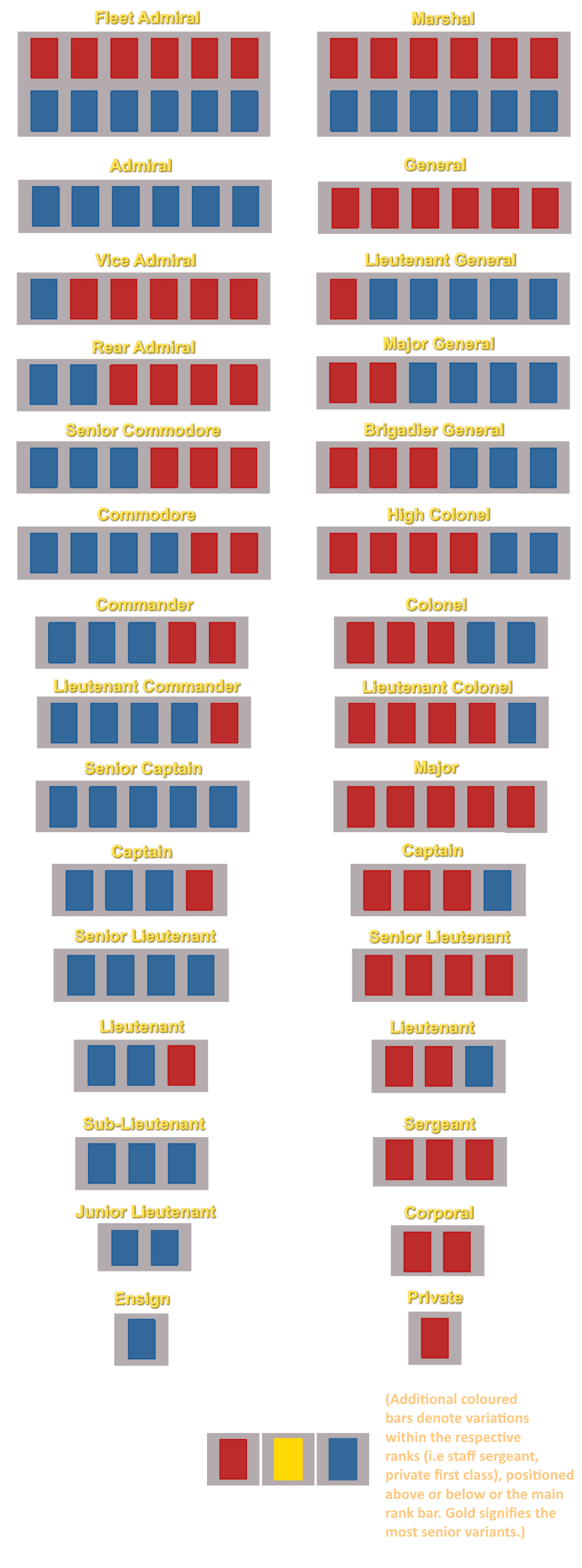
Judicial Forces Uniform and Armour

A Judicial Forces Ensign
|

A Judicial Forces Trooper
|

A Judicial Forces Officer
|

A Judicial Forces Scout
|

A Judicial Forces Pilot
|
Brief History
Created out of the shattered military forces of the various post-Dark Age Second Republic factions and tribes, the reconstruction of the Judicial Forces in the image of the First Republic's 'Golden Age' peacekeeping force was undertaken by a joint staff of Reborn Jedi and inaugural senators of the new government. Chartered by Supreme Chancellor Valaha, the New Judicial Forces were to be managed, primarily, by the civilian government, but with a strict military and naval ranking system of its own, internally.
Given the excesses of the Old Republic and Palpatine's Empire - for which an oversized military and heavy-handed government were held responsible for causing - the Judicial Forces of this new age were kept to minimal sizes, being sufficient to deal with local skirmishes, uphold galactic law, and support sectors with any developing unrest. Designed to respond to immediate crises and to protect the frontier, it was expected that the various local sectors, the Jedi, and other organisations with vested interests in, and loyalty to, the Third Republic would bolster the forces in times of war, both big and small. During the First and Second Outer Rim Conflicts, this happened with GalactaWerks and other affiliated groupings swelling the Republic military with their own marines and militias, whilst many Reborn Jedi assumed leadership roles in the latter conflict.
Although the Third Republic's founding philosophies abhor war and do not glorify the tenets of strife and conflict, they do nevertheless venerate those that fought for, and would still die for, the peace and security hard-won for galactic civilisation. As such, there are several dedicated war colleges still scatted through some of the Core Worlds and the strongly-loyalist entities within the Republic. However, given the limited nature of the Judicials and the highbrow impression of the forces, these are typically frequented by the families of nobles and political figures, which has largely resulted in an upper-class leadership with vested political interests. Even so, there is still a large enlisted presence within the naval and military elements, although the fleet's resources generally call upon local sectors and businesses for aid. It also usually falls to these sectors to businesses to push the frontier for exploration and transportation of resources, the Judicial Forces being too limited in scope to fulfil these requirements.
GALACTIC SENATE
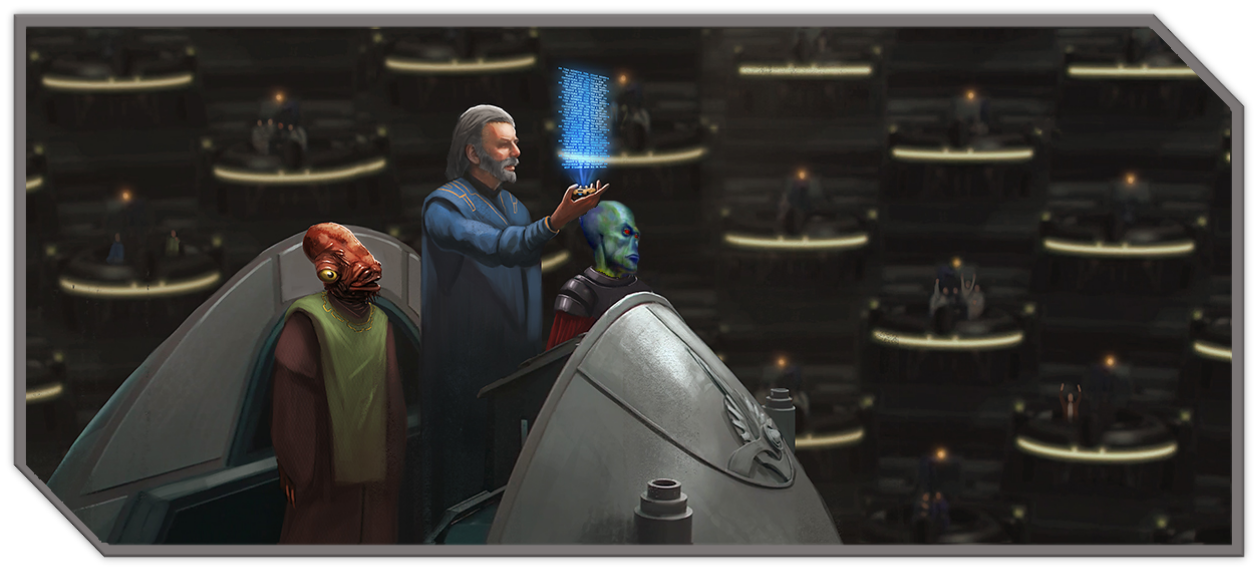
Above: Lin Viatha (Chief of Staff), Supreme Chancellor Octavus Paralles, Speaker Damask Hul (Vice Chair)
KEY (Political Affiliations)
 Coalition
 Centrality
 Outer Rim Alliance Bloc
 No Affiliation
LIST OF SENATORS/REPRESENTATIVES
(Note: figures from Outer Rim Alliance worlds that sit within the Senate are deemed "Representatives of the Alliance", holding less sway and authority than full senators, but still providing those worlds with insight to Senate dealings. Special 'Delegates' are appointed to attend meetings and key legislative events with voting rights. The Alliance-aligned worlds not within the ORA remain full Republic members.)
COALITION (Political Grouping)

- Leader(s):
- Notable aligned/supporting planets (not exhaustive):
- New Alderaan
- Ciutric IV
- Susevfi
- Carida
- Corulag
- Chandrila
- Agamar
- Murkhana
- Sullust
- Zygerria
- Sermeria
- Chalacta
- Esseles
- Fondor
- Corulag
- Skako
- Neimoidia
- Foerost
- Corellia (mixed support)
- Centares (mixed support)
The "Coalition" (an informal name initially given and later adopted by the grouping) is a loose political alliance between numerous more liberally-minded factions within the Third Galactic Republic. It is typically supported by individuals and organisations that prize the human/sentient rights of sentients highly, whilst balancing these with libertarian economic values, holding core to the belief that such libertarianism will innately feel into the well-being of the galaxy's citizens through its very nature.
Currently the largest faction within the Galactic Senate, the Coalition's figurehead and leader is Supreme Chancellor Octavus Paralles, who holds true to the values of personal liberties, equality, and free enterprise. However, his Senate faction still holds minority sway, even if the largest, which has forced Paralles and the Coalition into an alliance with the next largest grouping within the Senate: the Centrality, led by the Vice Chancellor.
The Coalition, and by extension the office of the Supreme Chancellor, is strongly bank-rolled by GalactaWerks and other large corporations, who strongly influence the decision-making and fiscal policy of the Coalition, whilst also providing it with naval and military might for its engagements, having effectively served as the Republic armed forces during the Outer Rim Conflicts.
Deeply-devoted to the founding principles of the Third Republic's Grand Proclamation, the Coalition strives to minimise government size and intervention, believing in small expenditure, low taxation, minimal armed forces, with liberal policies focusing strongly on the identity of sentients and equality for all, regardless of background or origin - although this sometimes contradicts the background GalactaWerks involvement and perceived corruption that accompanies it.
In recent years, the Coalition has come under heavy criticism, accompanied by waning support. This criticism derides the Republic for having become stagnant and corrupt; the Republic is defenceless but for a small Judicial force and the mercies of corporations, as well as the belief that the rights - or rather, the feelings - of the few are taking precedence over the prosperity of the state and its people as a whole. There is a great concern over the growing influence of GalactaWerks, as well as the apparent inability of the Republic to face off further threats from secessionist groups who old control over key resources, such as the agriworlds of the Outer Rim Alliance. These critics have found a home in the Centrality.
CENTRALITY (Political Grouping)

- Leader:
- Notable aligned/supporting planets (not exhaustive):
- Eriadu
- Cerea
- Malastare
- Atzeri
- Cato Neimoidia
- Champala
- Denevar
- Chasin
- Commenor
- Fondor
- Jabiim
- Kuat
- Alsakan
- Anaxes
- Serenno
- Corellia (mixed support)
- Centares (mixed support)
- Grizmalt
- Humbarine
The Centrality started as a pressure group within the Third Republic; a grouping of like-minded senators and political commentators who were deeply concerned about the direction the Coalition-led Republic was going, especially after the two Outer Rim Conflicts and the growing might of GalactaWerks. It now exists as the second-largest political faction within the Senate and has numerous powerful worlds supporting and financing its agenda whilst it helps form a government alongside the Coalition.
Led by former intelligence operative and political agitant Damask Hul, the Centrality has grown immeasurably in support following the Second Outer Rim Conflict. A man willing to compromise, Supreme Chancellor Paralles was quick to involve the Centrality within the policy-making process of the Republic as a means to quell further dissonance within the Republic's own ranks, making Damask Hul the Speaker of the Senate and his Vice Chancellor.
The Centrality abhors the direct involvement of corporations in the day-to-day activities of the Third Republic, believing such matters rest with the state and people of authority - not those led by finance. Whilst the Centrality maintains self-determination is a key tenet in its philosophies, it maintains that state funding should be focused on the security of the nation and overall welfare and prosperity of the galaxy, rather than isolated regions or peoples. The Centrality argues for expanding the Judicial forces into a full armed service and in giving greater powers to security authorities, whilst also centralising more powers within the Galactic Senate, rather than the corrupt and bloated organisation that they currently believe dominates the Republic.
Often derided as being amoral, authoritarian and alarmist, the Centrality, with its banners and military manner, is accused of being an echo of more imperialistic times, with the accusation being that the rise of the Centrality as the key power would result in the abuse of individuals' rights and a grossly-powerful central government that is fixated on paranoia and cultural superiority. Even so, the Centrality is finding strong support even amongst the working classes of several species within the Republic, particularly as GalactaWerks invades their lives, along with the fear of the Outer Rim Alliance holding them to ransom once more.
However, it is widely known and accepted that in their current states, neither faction can control the Senate or the Republic without the other's support.
OUTER RIM ALLIANCE BLOC (Political Grouping)

-
Leaders:
& Representative Gial Bok (Mon Cal male) (ORA-aligned Senate figurehead)
- Notable member planets (not exhaustive):
- Rhen Var
- Alba (Capital)
- Belsmuth
- Cathar
- Felucia
- Kashyyyk
- Anzat
- Ruusan
- Umbara
- Taanab
- Togoria
- Sneeve
- Charros
- Bimmisaari
- Ultaar
- Saleucami
- Boonta
- Roche
- Vjun
- Junction
- Sy Myrth
- Ord Yutani
Notable ORA-aligned planets (not formalised members; have full Senate representation):
- Iridonia
- Glee Anselm (Glee-Namadii Star Collective)
- Bothawui (Bothan Space) - destroyed, 1,218 ABY
- Manaan
- Mindor
- Naboo
- Ryloth
- Telos
- Dantooine
- New Dac/Mon Calamari
- Iego
- Centares (mixed support)
- Ord Yutani
- Onderon
Following the conclusion of the Second Outer Rim Conflict and the signing of the Belsmuth-Quelli Treaty in 1,195 ABY, the reformed Outer Rim Alliance was afforded a protectorate status as a semi-autonomous state within the Third Galactic Republic. Whilst this was seen as a halfway house compromise in which neither side was truly victorious, given the ORA was still beholden to the Republic and the Republic was seen to lose face to the separatists, it has preserved the peace in the two decades since.
As the ORA was afforded heavy legislative powers within its borders, but subjected to numerous enforced trade agreements and militaristic constraints, its member worlds had their political sway within the Galactic Senate accordingly diminished. Formal ORA member worlds within their borders had their senators stripped of their diplomatic status, and were instead replaced by Representatives. These representatives still attend Senate sessions and may engage in discussion regarding Republic law, but they do not get to propose legislation or vote on most issues, unless they directly affect ORA member worlds or are ORA-Republic issues. Instead, three Delegates of the Alliance, appointed and agreed by both the Republic and the ORA, are given voting privileges and legislative powers within the Senate, although they typically serve as ambassadors and figureheads for the ORA within the Senate.
Many worlds supported the ORA during the Second Outer Rim Conflict without becoming full formalised members, either due to distance or because no treaties were ratified to make their alliance wholly legal. When the war was concluded, most worlds falling outside of the clearly recognisable and legal borders of the ORA were retained as full Republic member worlds. Whilst many faced sanctions and held dim views of their own on Republic proceedings henceforth, they retained their sector senators and voting rights. Given the tense political dynamics within the Senate during the 1,200s, they have formed a political voting bloc generally opposed to the Coalition-Centrality majority currently reigning. Whilst the representatives do not get full votes, the ORA-supporting senators of worlds still somewhat loyal to ORA ideals will vote in line with their opinions and do their best to insert Alliance views on the voting process, although they are heavily outnumbered by the ruling Coalition-Centrality bloc.
Upon Octavus Paralles' ascension to the chancery, he made efforts to further repatriation with his rivals by appointing a Mon Cal chief of staff within his organisation, although this token effort has largely been ridiculed by all parties. The current recognised leader of the senator/voting portion of the bloc is Senator Gial Bok of New Dac.
LIST OF SUPREME CHANCELLORS
-
380 ABY: Valaha (Bith male - from Clak'dor VII)
The inaugural holder of the reinstated title of Supreme Chancellor of the Galactic Republic, Valaha was one of the architects of the Grand Proclamation and Third Republic. He enjoyed close relations with the New/Reborn Jedi Order Grand Master Junun Waay and their relationship paved the way for future chancellors involvement with the Order. There are numerous busts and statues that have been erected in his honour. He died elderly and popular, becoming a senator again upon the conclusion of his second (and final permitted) term, and was honourarily still engaged at the highest levels of government as the Third Galactic Republic moved from a conceptual notion to a fully-realised galactic state towards the end of the 400s ABY.
-
1,184 - 1,192 ABY: Grym Oro (Skakoan male - from Skako)
Considered a war-hawk by both his contemporaries and historians, Supreme Chancellor Oro rose to power amidst numerous scandals that elevated him into a position of authority over his less credible, more moderate opponents. Supported by militarists and corporate interests alike, Oro was the chancellor that presided over the initial stages of the Second Outer Rim Conflict. Although there was talk of emergency legislation permitting Oro a third term during the political crisis and war, this was ultimately brought down by more moderate figures, with public opinion increasingly working against the Skakoan. Oro is remembered for his lofty promises and mishandling of basic facts and figures, but also his tactical prowess and stubborn militaristic intuition. Oro has since died from congenital medical complications.
-
1,192 - 1,196 ABY: Luscia Sheld (Neimoidian female - from Neimoidia)
A particularly moderate and diplomatic figure with fewer corporate connections, Supreme Chancellor Sheld was considered everything that Oro had not been: a reasonable and approachable individual, seeking a genuine solution to the war that benefited all parties. However, whilst Sheld presided over the Belsmith-Quelli Treaty that ended the Second Outer Rim Conflict, she was particularly derided for the terms of the treaty and subsequent recognition of the ORA as a protectorate, which many in the Republic saw as a betrayal. Sheld stood down after one term, but is remembered more fondly by more recent historians, with Octavus Paralles citing her as a personal inspiration. Nothing has been seen nor heard from Sheld in the years since her premiership.
-
1,196 - 1,204 ABY: Gud Pruuva (Sullustan male - from Esseles)
An easy-going and pleasant figure, Pruuva is remembered as an ineffectual but crowd-pleasing leader of the Third Republic. Ruled more by his cabinet and committees, Pruuva became infamous for his various affairs, but also his charitable nature, readily investing in numerous schemes that he felt would benefit various groups. It was often rumoured that GalactaWerks and other groups had free reign over the Republic and the Senate during his rule, and it was a surprise when he returned for a second term. He has retired to a family estate on Esseles.
-
1,212 - ??? ABY: Octavus Paralles (Human male - from New Alderaan)
The incumbent Supreme Chancellor of the Third Galactic Republic, Chancellor Paralles is now in his second term of office. An apologist and mediator, Paralles formed a political alliance with his Senate opponent, Damask Hul, against all expectations, against the backdrop of accusations of administrative corruption and corporate interests controlling the Senate.
Categories: Species and Factions