New Mandalorian Crusade (301 - 321 ABY)
Created by Darth Serus on Thu Oct 4th, 2012 @ 7:01pm
New Mandalorian Crusade
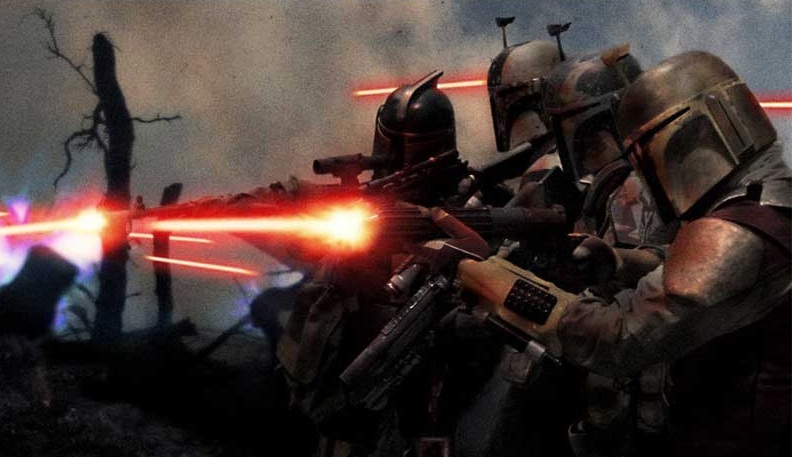
"We are preaching hope, standing upon the bones of the past. For the dead and the living, we must bear witness." – Valaha, eventual first Supreme Chancellor of the Third Republic, at the war's conclusion.
- Beginning: 301 ABY
- End: 321 ABY – New Galactic Dark Age
- Place: Galactic Federation Triumvirate space
OUTCOME
-
Pyrrhic Federation victory
- Eventual reformation of the Galactic Federation Triumvirate into the Third Galactic Republic via the Grand Proclamation
- Reformation of the New Jedi Order into the Reborn Jedi Order via the Grand Proclamation
-
Beginning of the Great Mandalorian Civil War
- The Mandalorian Defenders emerge on the side of the Federation and push back the True Mandalorians
- Two distinct Mandalorian cultures formally emerge
- Major battles: see below
| COMBATANTS | Galactic Federation Triumvirate | True Mandalorians |
|---|---|---|
| Mandalorian Defenders (from 319 ABY) | ||
| COMMANDERS | TBD | TBD |
In 301 ABY, the New Mandalorian War (also known as the New Mandalorian Crusade) broke out under the leadership of Mandalore the Undefeated. The self-styled "True Mandalorians" – having been reunited under Boba Fett during the Yuuzhan Vong War – launched a crusade intended to defeat and supplant the Galactic Federation Triumvirate.
While initially devastating, the invasion ultimately proved counterproductive. The Alliance, Imperial remnants, and the Jedi within the Triumvirate were forced into unprecedented cooperation, hardening political and military unity even as the Federation struggled to sustain full-scale warfare against a culturally unified Mandalorian foe.
After nearly two decades of fighting, a schism emerged in 319 ABY. A dissident faction of Mandalorians rejected Mandalore the Undefeated’s war against the wider galaxy. Led by their own Mandalore – Mandalore the Divider – they became known as the Mandalorian Defenders, siding openly with the Federation and igniting the Mandalorian Civil War.
Exhausted and bloodied by years of conflict, the Federation withdrew from direct warfare, instead supplying the Defenders as proxies. The wider galaxy entered a period of fragmentation and decline.
By 321 ABY, during a prolonged internal engagement, Mandalore the Undefeated was betrayed and killed by one of his closest advisors. Rather than ending the war, his death accelerated internal collapse, with armies and clans changing allegiances repeatedly. From this chaos emerged a new leader among the True Mandalorians – Mandalore the Staunch.
NARRATIVE AND LEGACY
Historical consensus holds that the New Mandalorian Crusade marked the final collapse of the old post-Yuuzhan Vong equilibrium. While the True Mandalorians framed their war as a reclamation of honour and unity, contemporaneous records suggest that their ideology was far from monolithic. Deep divisions existed between clans that had rebuilt themselves in isolation after the Vong War and those that had grown increasingly entangled with corporate interests, including arms manufacturers and logistical conglomerates that would later form the core of GalactaWerks. Precursor entities such as Czerka Arms and Baktoid Armour are repeatedly cited in fragmentary accounts as suppliers, advisors, and profiteers, embedding themselves within Mandalorian power structures long before the war reached its zenith.
The emergence of the Mandalorian Defenders exposed a philosophical fault line that had long gone unacknowledged. Where the True Mandalorians pursued conquest as cultural validation, the Defenders argued that Mandalorian survival lay in continuity rather than domination. Their decision to side with the Federation was not rooted in loyalty to its institutions, but in a belief that endless crusade would annihilate Mandalorian identity entirely. In later centuries, Defenders would be remembered by the state histories of Manda'toma as founders, while Exile traditions would brand them as traitors. This dichotomy reflects how thoroughly the war fractured Mandalorian historical memory.
The Jedi perspective on the conflict is similarly divided. Surviving Reborn Jedi texts portray the war as a cautionary tale against cultural absolutism and militarised identity, drawing explicit parallels with the failures that had preceded the Yuuzhan Vong invasion. However, the destruction of archives during the New Galactic Dark Age, the period encompassing the later Mandalorian conflicts and the wars against Darth Krayt's Empire, means that much Jedi involvement remains poorly documented. What survives is often contradictory, mythologised, or shaped by post-war necessity, leaving modern scholars uncertain how unified or effective the Jedi truly were during this era.
By the time the Grand Proclamation was issued, much of the galaxy's recent history had already been lost. Worlds lay depopulated, records burned, and entire political traditions erased. Yet from this devastation emerged a rare convergence of actors willing to compromise. Surviving Federation institutions, chastened Jedi leaders, Mandalorian moderates, and pragmatic political figures such as Valaha drew lessons from both the Mandalorian wars and the Yuuzhan Vong catastrophe. The Third Galactic Republic and the Reborn Jedi Order were forged not as restorations of the past, but as deliberate attempts to prevent its repetition. Even so, the unresolved tensions, buried grievances, and corporate entanglements of the New Galactic Dark Age ensured that the peace which followed would be fragile and temporary.
SEMI-LEGENDARY CONFLICTS AND CONTESTED EVENTS
Much of the military history of the New Mandalorian Crusade is obscured by deliberate record destruction, systemic collapse, and the subsequent mythologising of the New Galactic Dark Age. As a result, a number of engagements are recorded only in fragmentary archives, oral traditions, or partisan accounts. While no inhabited worlds are believed to have been destroyed outright, the scale of infrastructure loss, archive annihilation, and population displacement during this period permanently altered the galactic historical record.
-
The Ashfall Convergences (circa 304-309 ABY)
A loosely attested series of system-wide engagements and planetary sieges, remembered primarily for the destruction of data vaults, astrogation archives, and pre-war census repositories. The Convergences are believed to have erased vast portions of early post-Vong historical material across multiple regions. -
The Long Silence of the Perlemian Reach (circa 307 ABY)
A prolonged communications blackout affecting several Perlemian-adjacent sectors. Whether caused by Mandalorian interdiction, Triumvirate countermeasures, or unknown third-party interference remains disputed. Entire administrative chains vanished from the historical record during this period. -
The Siege Without Names (circa 311 ABY)
A term used in later Jedi and civilian texts to describe a series of unrecorded ground wars whose participants and locations cannot be conclusively identified. Surviving references emphasise the loss of civilian infrastructure and the forced relocation of populations rather than decisive military outcomes. -
The Betrayal of Bastion (circa 314 ABY)
One of the most consistently referenced yet least explained events of the Crusade. During a major Triumvirate fleet engagement, Imperial forces abruptly disengaged and withdrew in full, abandoning allied formations without warning. Shortly thereafter, Imperial remnants vanished from galactic politics, retreating into seclusion and eventually re-emerging as the Bastion Moff Empire. Contemporary accounts vary between accusations of calculated withdrawal, internal schism, or premeditated secession. -
The Closing of the Unknown Regions (early Crusade period)
Early in the conflict, the Chiss Ascendancy enacted a total blockade of the Unknown Regions. All non-Chiss traffic was expelled, and any vessels that subsequently entered were never heard from again. Simultaneously, Chiss representatives and assets withdrew from known space. No official declaration accompanied this action, and its motivations remain speculative.
The war also precipitated an unprecedented influx of Force-sensitive children into Jedi custody. With traditional recruitment structures collapsing and entire communities displaced, large numbers of younglings were inducted under emergency doctrines. Many were trained rapidly, with reduced archival grounding and a heightened emphasis on discipline, obedience, and institutional legitimacy. These cohorts would later form the ideological backbone of emerging Waayist philosophy, shaping the Reborn Jedi Order into a more rigid and inward-looking institution.
In retrospect, scholars increasingly argue that the New Mandalorian Crusade cannot be understood as a single coherent war, but rather as a convergence of overlapping catastrophes. Corporate entanglements, ideological absolutism, and the gradual erosion of shared historical truth combined to create a period where myth and fact became indistinguishable. By the time the Third Galactic Republic and Reborn Jedi Order formally emerged, much of what had occurred had already passed beyond reliable reconstruction.
→ Back to the Conflicts & Wars
Categories: Conflicts and Wars