Mandalore
Created by Bomoor Thort on Wed Jan 31st, 2018 @ 4:52pm
Mandalore
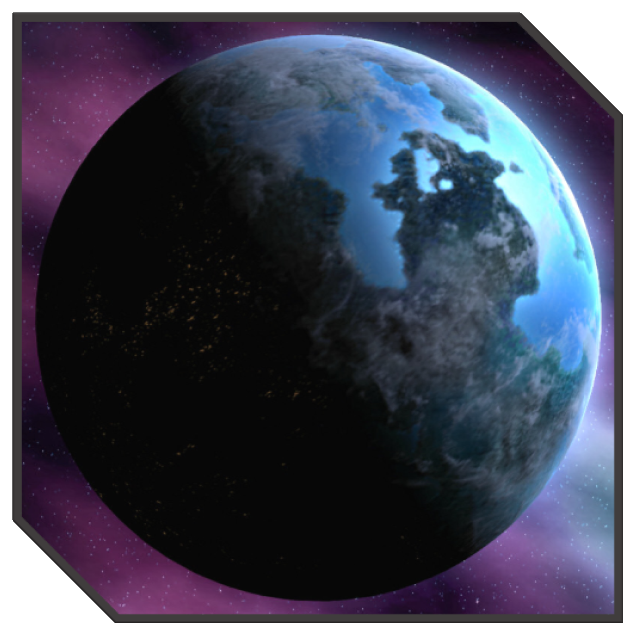
"There is no greater honour than for a warrior to die in service to his Mand'alor. Yet there is no greater honour for a Mand'alor than to die for his people." – Traditional Mandalorian proverb
Basic Information
ASTROGRAPHICAL
- Region: Outer Rim Territories
- Sector: Mandalore Sector
- System: Mandalore System
- Primary: Mandalore
- Orbital position: Fifth planet
- Moons: 2 (including Concordia)
- Grid coordinates: O-7
- Distance from Core: 28,666 LY
- Rotation period: 19 standard hours
- Orbital period: 366 local days
PHYSICAL
- Class: Terrestrial
- Diameter: 9,200 km
- Atmosphere: Type I (breathable)
- Climate: Temperate, arid, alpine and tropical
- Gravity: Standard
- Primary terrain: Grasslands, forests, mountain ranges, inland seas, deserts and jungles
- Native flora: Veshok trees, Galek trees, Amber ferns, Vormur blooms, Varos shrubs, Concordian pines, Razorgrass, Irongrass, Stone moss, Blood reed
- Native fauna: Mythosaurs (extinct), Strills, Shriek-hawks, Shatuals, Vhe'viins, Fanned rawls, Massiffs, Fyrnocks, Rupings
- Points of interest: Kyr'taung, Keldabe, Sundari (ruins), Horuz Orbital Shipyards, The Field of Embers
SOCIETAL
- Native species: Taung (extinct)
- Immigrated species: Predominantly Human, alongside numerous adopted Mandalorian peoples
- Primary language(s): Mando'a, Galactic Basic Standard
- Government: Court of Mandalore
- Current ruler: Mandalore the Provider
- Population: Moderate; dispersed amongst clans and keeps
- Demonym: Mandalorian
- Capital: Kyr'taung
- Affiliation: Manda'toma (The Mandalorian Empire)
Description
Mandalore is the ancestral homeworld of the Mandalorian people and the political, spiritual and historical heart of Manda'toma. Although the Mandalorians long ago spread across countless worlds, every clan ultimately traces its lineage, traditions and legitimacy back to Mandalore, whose soil is regarded as sacred regardless of political allegiance.
Unlike many galactic capitals, Mandalore has never developed into a planet-spanning ecumenopolis. Vast forests, rolling plains, towering mountain ranges and inland seas dominate its surface, interrupted only by scattered clan keeps, military fortresses and carefully planned settlements. The preservation of the landscape is considered a duty owed to the ancient Taung, with successive Mandalores discouraging unnecessary urban expansion in favour of maintaining the world's natural character.
Dominating the central plains is Kyr'taung ("Honour of the Taung"), the immense black spire serving as palace, fortress and seat of government. Visible from orbit and rising seemingly impossibly above the surrounding grasslands, it houses the Court of Mandalore, the Genet'aliit, the Beskar'verda and the ceremonial chambers of Mandalore himself. Around it stretches the Field of Embers, preserved as the site where the Mandalorian Defenders secured victory during the Civil War that gave birth to Manda'toma.
Although the planet has endured countless wars throughout its history, Mandalore remains one of the most heavily defended worlds in the Outer Rim. Orbital defence fleets, fortress complexes and extensive planetary batteries protect the homeworld, whilst the surrounding clan worlds and Horuz orbital shipyards ensure that any assault upon Mandalore would inevitably become a campaign against the Empire itself.
History
Ancient Mandalore
The accepted history of Mandalore prior to approximately 130 ABY broadly follows surviving Republic, Imperial and Mandalorian historical records. Following their exile from Coruscant, the Taung settled the planet and established Manda'yaim, forging a culture of survival through constant warfare against the world's formidable wildlife. The extinction of the mythosaurs, whose skull became the enduring emblem of Mandalorian civilisation, marked the beginning of the Mandalorian Creed and the first great expansion beyond the homeworld.
Across the following millennia Mandalore became synonymous with conquest. The Mandalorian Crusades, Neo-Crusaders, repeated conflicts with the Republic and Jedi Order, Imperial occupation and later restorations all reshaped the clans whilst preserving the planet's symbolic importance. Although political unity rose and fell many times, Mandalore itself remained the unquestioned homeland of the Mandalorian people.
Historical accounts diverge significantly following the collapse of the Fel Empire and the onset of the New Galactic Dark Age. Much of the subsequent history survives only through Mandalorian oral tradition, clan chronicles and later archaeological study.
The New Galactic Dark Age
The collapse of galactic authority ushered in centuries of fragmentation across Mandalorian space. Clans increasingly acted independently, frontier holdings were abandoned or absorbed by local powers and competing interpretations of the Mandalorian way emerged. Whilst some leaders sought renewed crusades, others argued that endless warfare threatened the survival of Mandalorian civilisation itself.
It was during this tike that the Mandalorian Defenders gradually emerged, advocating unity beneath a permanent Mandalore whilst preserving clan autonomy. Their rivals, the New Mandalorian Crusaders, had embarked upon a destructive new galactic campaign against the remnants of the Fel Empire and Second Republic, which the Defenders objected to, setting the stage for the largest strife within their culture across history. Even so, the Crusade brought about a New Galactic Dark Age that would not end for much of the galaxy until the formation of the Third Galactic Republic.
The Mandalorian Civil War
The Mandalorian Civil War engulfed the homeworld. The conflict culminated upon the central plains of Mandalore, where Mandalore the Divider achieved a decisive victory over the Crusader host. The battlefield burned for days, becoming immortalised within countless stone reliefs depicting the defeated Crusaders consumed by fire beneath the triumphant banners of the Defenders.
Many surviving Crusader clans accepted the new order and remained upon Mandalore. Others rejected the authority of Mandalore the Divider entirely, departing the system to become the first of the Mandalorian Exiles. Construction of Kyr'taung began upon the battlefield shortly afterwards, its foundations laid amongst the ashes of the conflict as a permanent symbol that Mandalorian civilisation would never again be permitted to fracture so completely.
The Rise of Manda'toma
The centuries following reunification saw the transformation of Mandalore from the symbolic heart of wandering clans into the capital of a permanent empire. Clan rights were codified, the Court of Mandalore established, the Genet'aliit formally recognised and the Beskar'verda founded as the Empire's Force-sensitive knightly order. Uniform armour standards, military doctrine and systems of petition allowed Mandalorians and worthy outsiders alike to join the Empire whilst preserving ancient traditions.
Manda'toma gradually expanded across neighbouring systems through diplomacy, inheritance and selective conquest, incorporating worlds such as Agamar, Wayland, Myrkr and Taris. Dathomir was eventually conquered following campaigns against the Nightsisters that still remained in small numbers upon the planet, thereafter becoming a sacred hunting world and proving ground for generations of Mandalorian warriors and knights.
Throughout this period, Mandalore itself remained comparatively untouched by industrialisation. Rather than sprawling cities, successive Mandalores invested in orbital infrastructure, shipyards, clan keeps and defensive fortifications, ensuring the homeworld retained both its natural beauty and unparalleled strategic importance.
The Bastion Wars
Relations between Manda'toma and the Bastion Moff Empire deteriorated repeatedly across five major wars, largely driven by the actions of the Mandalorian Exiles, whose raids upon Imperial territory frequently drew retaliation against the Mandalorians as a whole. Despite prolonged periods of hostility, neither power proved capable of delivering a decisive strategic defeat upon the other.
The most serious threat to Mandalore itself occurred during the Fifth Bastion War, when Grand Admiral Willem Stert deceived Mandalore the Provider into committing the majority of the Mandalorian fleet elsewhere before Admiral Stellos Geldair launched the infamous Sacking of Mandalore. Although Bastion never occupied the world, the assault inflicted severe infrastructural damage and demonstrated that even the Mandalorian homeworld was not beyond the reach of modern warfare.
Following the war, Mandalore underwent the largest defensive expansion in its history. Horuz was transformed into the empire's principal naval construction complex, specialist clans assumed permanent responsibility for orbital defence and planetary fortifications were modernised throughout the system. Today, Mandalore is regarded as one of the most heavily defended planets in the Outer Rim.
Flora and Fauna
Despite thousands of years of habitation, Mandalore retains an exceptionally diverse biosphere. Vast Veshok forests and Galek groves dominate much of the temperate regions, whilst Razorgrass plains and flowering Vormur meadows surround the central heartlands. Many clan rituals remain closely tied to the natural landscape, reflecting the belief that the world itself forged the Mandalorian people.
The planet remains home to numerous dangerous predators including Strills, Shriek-hawks, Vhe'viins and Fanned Rawls, creatures traditionally hunted as rites of passage by young Mandalorians. The greatest of all native beasts, the mythosaur, is believed to have become extinct thousands of years ago after prolonged hunting by the ancient Taung. Nevertheless, rumours periodically emerge claiming that living mythosaurs have been sighted within unexplored regions of Mandalore or secretly recreated through advanced genetic engineering. Others whisper that stranger forces—forgotten alchemy, ancient technology or powers beyond conventional understanding—may have played a role. No credible evidence has ever substantiated these claims, yet the stories persist, ensuring that the mythosaur remains not only the greatest symbol of Mandalorian history, but also its greatest enduring mystery.
→ Back to Planets
Categories: Planets